
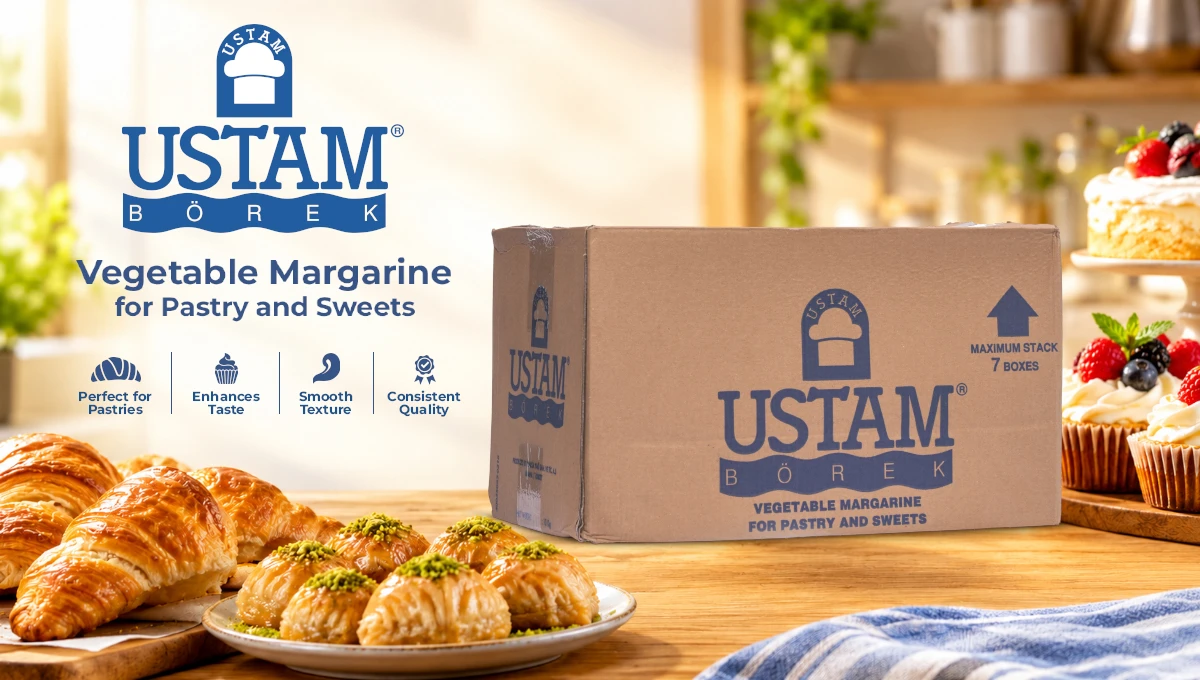
In professional baking, exceptional results rarely come from a single ingredient. They come from the careful balance of technique, temperature, texture and quality ingredients. For pastry makers, bakers and food businesses, fat is particularly important because it influences everything from dough handling and layering to flavour, tenderness, crispness and appearance.
Ustam Borek Vegetable Margarine for Pastry and Sweets is developed with these requirements in mind. Designed for pastry applications and sweet baked products, it provides a smooth and workable texture that helps bakers create defined layers, rich-looking finishes and consistently appealing baked goods.
From laminated pastries and croissants to filled pastries, biscuits and sweet bakery creations, the right margarine can become an important part of the baking process. Ustam Borek brings together smooth texture, pastry performance, taste enhancement and consistent quality in a format suited to professional and commercial baking environments.
1. Understanding the Role of Margarine in Pastry Making
Pastry is one of the most technically demanding areas of baking. A seemingly simple dough can require careful control of ingredients, mixing, resting, rolling and baking to achieve the desired result.
Among these ingredients, fat plays a central role.
Margarine can influence the way dough behaves during preparation while also contributing to the final texture and eating experience. In laminated products, for example, the fat needs to work effectively between layers of dough. During preparation, it helps create separation between those layers, while baking transforms the prepared dough into a product with a distinctive flaky structure.
This is why professional pastry production requires more than simply adding a fat source to a recipe. Bakers need an ingredient that can be incorporated and worked effectively while maintaining the characteristics required by the application.
The Importance of Workability
A pastry margarine needs to be practical to handle. If it is difficult to spread or incorporate, it can interfere with the preparation process. An excessively inconsistent texture can also make it harder to achieve uniformity from one batch to another.
Ustam Borek is positioned around smooth and spreadable performance, giving bakers a workable ingredient for pastry and sweet applications. That workability becomes especially valuable in commercial baking, where production efficiency and consistency are just as important as the appearance of the finished product.
2. Designed for Pastries and Sweet Bakes
Ustam Borek Vegetable Margarine is specifically presented as a product for pastry and sweets, making it suitable for a broad range of bakery applications.
Pastry products can vary considerably in their ingredients and preparation methods. Some rely on laminated dough and multiple folds, while others require a rich, tender dough. Sweet bakery products may also demand a fat that supports texture while complementing the other ingredients.
The versatility of a pastry margarine allows bakers to work across different product categories without changing the fundamental ingredient approach for every recipe.
Potential Applications Include:
- Croissants and laminated pastries
- Danish-style pastries
- Filled pastries
- Sweet rolls and enriched doughs
- Puff-style pastry creations
- Biscuits and selected sweet baked goods
- Pastry shells and bases
- Bakery products requiring flaky or layered textures
- Sweet pastry preparations
The exact performance will naturally depend on the recipe, processing conditions and baking technique. However, the ingredient’s purpose remains clear: to support better pastry preparation and attractive baked results.
3. Smooth and Spreadable: Making Pastry Preparation Easier
One of the key characteristics highlighted for Ustam Borek is its smooth texture.
In pastry production, texture is not simply a sensory quality. It affects how an ingredient behaves during preparation.
A smooth, spreadable margarine can be easier to distribute across dough surfaces, helping bakers work more efficiently when preparing layered pastry. Even distribution is particularly important when the desired result depends on a controlled relationship between dough and fat.
For a pastry maker, this can mean a more manageable preparation process. Instead of fighting against an ingredient that is difficult to work with, the baker can focus on the technique itself: rolling, folding, shaping and preparing the dough for baking.
Supporting Consistency in Preparation
Consistency matters whether a product is being made in a professional bakery, hotel kitchen, restaurant pastry section or larger-scale food production environment.
When an ingredient behaves predictably, the baker can establish a repeatable process. This is especially important when producing multiple batches of the same product.
For commercial bakers, repeatability can ultimately contribute to:
- More consistent product quality
- Easier production planning
- Better control during preparation
- More uniform pastry structure
- A smoother workflow for bakery teams
4. Creating Flaky Layers
Few characteristics are as closely associated with quality pastry as flakiness.
The delicate layers found in products such as croissants, Danish pastries and other laminated creations are the result of carefully controlled dough preparation. Fat plays an important part in creating the separation needed to develop these layers.
The process requires patience and precision. Dough is rolled, layered and folded before being shaped and baked. During baking, moisture and heat interact with the dough and fat, contributing to the expansion and structure that gives laminated pastry its characteristic appearance.
Ustam Borek Vegetable Margarine is designed for this type of pastry application, helping bakers work toward defined, flaky layers.
The goal is not simply to make pastry richer. It is to support the structural qualities that make pastry enjoyable: visible layers, a delicate bite and an appealing contrast between crisp exterior and tender interior.
5. From Preparation to the Golden Finish
The visual appeal of baked goods is often the first thing consumers notice.
A well-prepared pastry should look inviting before it is even tasted. Golden colour, defined layers, a crisp-looking surface and carefully formed shapes all contribute to the perception of quality.
Ustam Borek is positioned to help bakers achieve the characteristic golden appearance associated with well-baked pastry.
Of course, colour development depends on several factors, including oven temperature, baking time, recipe composition and finishing techniques. Nevertheless, the choice of fat remains an important part of the overall formulation.
A successful pastry should ideally deliver more than colour alone. The outside should look crisp and appetising while the inside retains the appropriate tenderness for the particular product.
That combination is what transforms an ordinary baked item into something consumers want to reach for.
6. Enhancing the Taste of Baked Creations
Texture may define the structure of a pastry, but flavour completes the experience.
The fat used in baking contributes to the overall sensory profile of a finished product, working alongside ingredients such as flour, sugar, eggs, fillings, spices, nuts, chocolate and fruit.
Ustam Borek highlights taste enhancement as one of its key product benefits.
This is particularly relevant in sweet pastry, where flavour needs to remain balanced. The objective is to allow the pastry to complement the filling or topping rather than overpowering it.
Whether paired with fruit, cream, chocolate, nuts or other sweet ingredients, a well-formulated pastry provides the foundation on which the rest of the flavour profile can be built.
7. Why Consistent Quality Matters in Professional Baking
A bakery product may be prepared dozens, hundreds or even thousands of times. Customers expect the pastry they purchase today to deliver a similar experience to the one they enjoyed previously.
This makes consistency one of the most important considerations in commercial baking.
For professional bakers, consistency extends beyond flavour. It includes:
- Dough handling
- Product shape
- Layer development
- Texture
- Baking performance
- Appearance
- Portion control
- Overall eating quality
Ustam Borek highlights consistent quality as part of its proposition for pastry and sweet applications.
For businesses, this is particularly relevant because the ingredient becomes part of an established production system. A dependable ingredient can help bakers maintain the standards associated with their products and brand.
8. Ustam Borek in Laminated Pastry
Laminated pastry represents one of the clearest examples of where the relationship between dough and fat becomes critical.
The basic concept involves repeatedly layering dough and fat through a process of rolling and folding. When the prepared pastry enters the oven, the layers develop into the distinctive flaky structure associated with laminated products.
Products such as croissants and Danish-style pastries demonstrate the importance of this process.
The baker’s technique remains fundamental, but the margarine used in the process is also an important component.
A Successful Laminated Pastry Aims For:
Defined Layers
The individual layers should remain visible and contribute to the characteristic structure.
Flaky Texture
The exterior should offer the expected crisp, delicate bite.
Tender Interior
The centre should balance the crispness of the exterior rather than becoming excessively dry.
Attractive Colour
A well-baked pastry should develop an appetising golden appearance.
Consistent Shape
Uniform preparation contributes to both presentation and portion control.
Ustam Borek Vegetable Margarine is designed to support bakers working toward these characteristics.
9. Beyond Croissants: Exploring Sweet Pastry Possibilities
While laminated pastries may immediately come to mind when discussing pastry margarine, the possibilities extend much further.
Sweet pastry is an expansive category, encompassing products that range from delicate individual pastries to larger baked creations.
A professional baker can use pastry margarine as part of recipes where texture, spreadability and baking performance are important.
Fruit-Filled Pastries
Fruit fillings provide acidity, sweetness and moisture, while pastry creates the structure surrounding them. A well-prepared pastry base can provide a pleasing contrast to soft fruit fillings.
Nut-Based Pastries
Almonds, pistachios, hazelnuts and other nuts can be incorporated into pastries, fillings and toppings. The pastry provides a neutral and complementary base for these richer flavours.
Cream and Custard Pastries
Cream-based and custard-filled products benefit from pastry that offers structural integrity while maintaining a delicate eating quality.
Decorative Bakery Products
Pastry can also be shaped into visually distinctive products for bakeries, cafés, restaurants and hospitality establishments. In these applications, consistent dough handling and appearance become particularly important.
10. Supporting Professional Bakery Creativity
Ingredients are the tools through which bakers translate ideas into finished products.
The same basic pastry dough can be transformed into different products through shaping, filling, layering and finishing. This gives pastry makers considerable creative freedom.
A versatile pastry margarine can therefore become part of a wider creative process.
A bakery might develop its own signature pastry by combining:
A reliable pastry base + distinctive filling + creative shaping + finishing technique.
The result could be a classic product or a completely new interpretation.
For bakeries operating in competitive markets, this flexibility is valuable. Consumers are increasingly drawn to products that are visually appealing while still delivering familiar, satisfying flavours and textures.
11. From Bakery Production to the Consumer
Behind every attractive pastry is a production process that consumers rarely see.
They see the golden crust, the delicate layers, the filling and the final presentation. The baker, however, sees every stage that made that product possible.
There is mixing, preparation, rolling, folding, resting, shaping, proofing where applicable, finishing and baking.
Every stage can influence the final product.
This is why ingredient selection should be considered part of the broader production strategy rather than an isolated purchasing decision.
For professional users, a pastry margarine should fit naturally into the workflow while contributing to the desired characteristics of the finished product.
Ustam Borek is positioned around exactly these practical requirements: smooth texture, pastry suitability, taste enhancement and consistent quality.
12. Building Better Bakes Starts with the Right Foundation
The expression “better bakes” is ultimately about the complete experience.
A pastry should be enjoyable to prepare, attractive to look at and satisfying to eat. For a commercial baker, it should also be practical to produce consistently.
That means considering the ingredient from several perspectives:
Performance
Can it support the requirements of the pastry application?
Texture
Does it help achieve the desired balance between crispness, flakiness and tenderness?
Handling
Is it smooth and workable during preparation?
Appearance
Can it contribute to an attractive finished product when used correctly?
Consistency
Can the baker maintain a reliable production standard?
These considerations form the basis of professional pastry production.
13. Ustam Borek: A Practical Choice for Pastry Makers
Ustam Borek Vegetable Margarine for Pastry and Sweets brings together the characteristics that matter in pastry preparation.
Its smooth and spreadable texture supports practical handling. Its suitability for pastry applications makes it useful across a variety of baked products, while its positioning around flaky layers, enhanced taste and consistent quality speaks directly to the requirements of professional baking.
Whether used for classic pastries or new bakery creations, the product gives bakers a foundation on which they can build.
And while ingredients are important, great pastry will always remain a combination of ingredient quality and craftsmanship.
The baker’s skill determines how the dough is mixed, handled, layered, shaped and baked. Ustam Borek becomes part of that process, helping transform carefully prepared dough into finished products that look inviting and deliver the textures consumers expect.
14. The Craft Behind Every Golden Pastry
A beautifully baked pastry represents more than a recipe.
It represents precision.
It is the precision of measuring ingredients, controlling dough, managing temperature, developing layers and knowing exactly when a product is ready to leave the oven.
The final golden crust is simply the visible result of everything that happened before it. Ustam Borek Vegetable Margarine is designed to support that craft, providing pastry makers with a vegetable margarine intended specifically for pastry and sweet applications.
From the first stage of preparation to the final bake, the objective remains the same: create pastries with appealing structure, texture, taste and appearance.
Conclusion: For Better Bakes
Great pastry begins with the right foundation.
Ustam Borek Vegetable Margarine for Pastry and Sweets is crafted for bakers looking for a smooth, workable margarine suited to pastry preparation and sweet bakery applications. With an emphasis on pastry performance, smooth texture, enhanced taste and consistent quality, it provides a practical ingredient for creating a wide range of baked products.
From flaky laminated pastries to delicate sweet creations, the possibilities extend wherever good baking meets creativity.
Because behind every crisp layer, every golden finish and every pastry worth sharing is a combination of craftsmanship and the right ingredients.
Ustam Borek Margarine for Vegetable and Sweets. For Better Bakes.